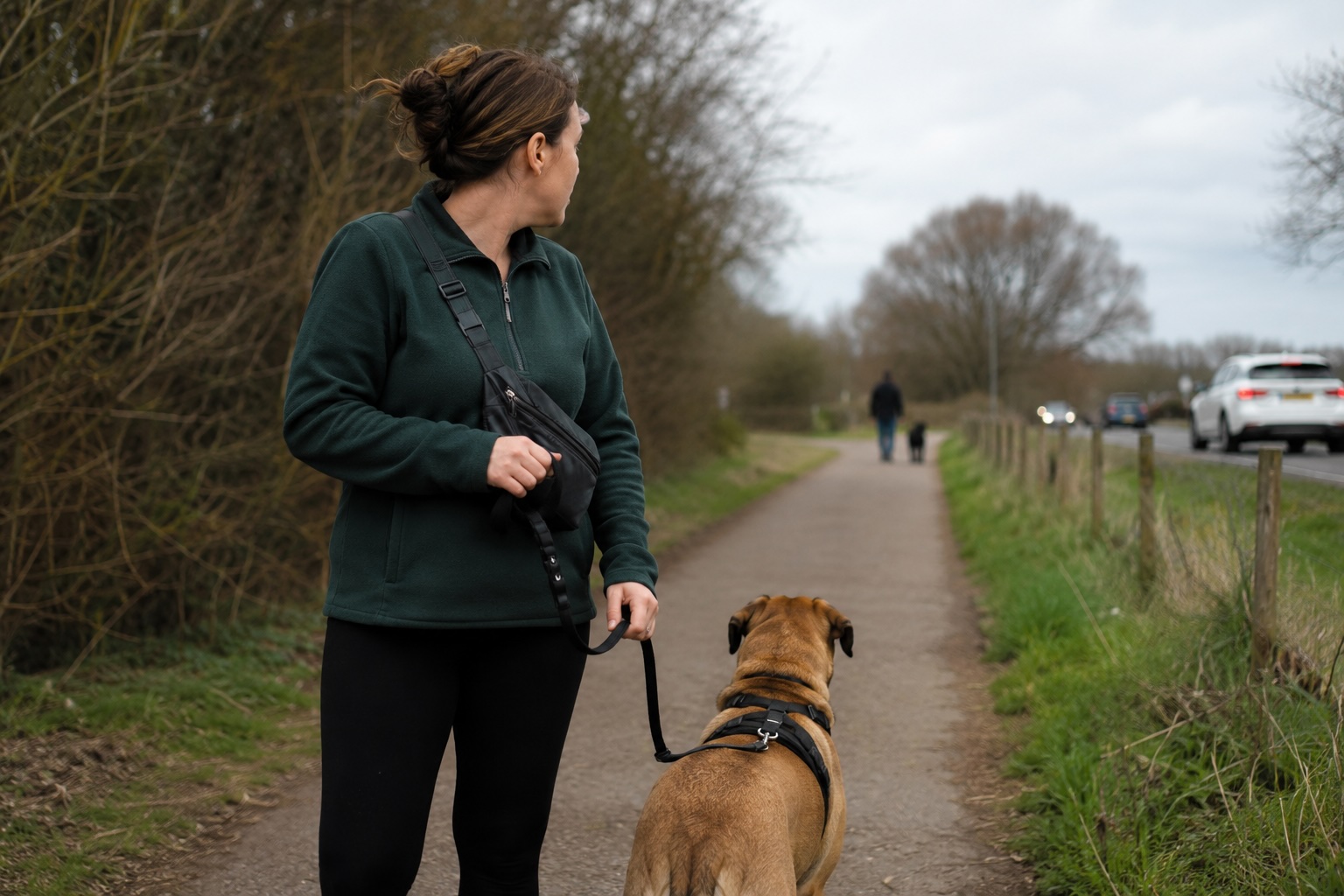
Your Nervous System Matters
Before we start teaching your dog, we need to start with the person holding the lead.
Many reactive dog owners spend every walk waiting for something to happen. You scan the environment, tighten the lead, hold your breath and brace yourself for the next reaction. After enough difficult experiences, this becomes automatic.
The important thing to understand is that this isn’t your fault, but it does affect your dog.
Dogs are incredibly good at reading changes in our body language, breathing, movement and tension. Long before we give a cue, they are already gathering information from us. That means our own nervous system becomes part of the training process, whether we realise it or not.
The good news is that your nervous system is just as trainable as your dog’s.
In today’s lesson you’ll learn:
- Why your body responds automatically when you anticipate a reaction.
- How dogs pick up on your stress and tension.
- Why this isn’t about blame—it’s about understanding.
- The first step towards becoming a calmer, more confident handler.
Your task today
Don’t try to change anything yet.
Simply become aware of what happens in your own body during your walks.
Notice:
- Do you hold your breath?
- Do your shoulders lift?
- Does your grip on the lead tighten?
- Does your jaw clench?
- Do you find yourself constantly scanning ahead?
Awareness always comes before change.
The more you notice these automatic responses, the more control you’ll have over them as we progress through the challenge.
Remember, over the next four weeks we’re not just helping your dog feel safer—we’re helping you feel safer too. When both ends of the lead begin to change, that’s when the biggest breakthroughs happen.
Hi
I noticed today even before listening, that I continually scan for
Dogs and people. I also have a habit of taking a deep breath when I see a dog or person.
Hi Claire,
My reaction to catching sight of an oncomming trigger (dog) is (1) clentch my teeth/jaw tightens (2) reduce the length of the lead & tighten my grip (3) breath quickens (4) scanning looking for a away to increase distance/find a way out (5) walking pace may quicken to reach an escape route (6) tension in my arms & shoulders.
Yikes…..a lot to work on here…no wonder my dog loses her mind!
Hi there, I call peanuts walks my zombie walks as I’m totally scanning for other dogs, never relaxed and always vigilant. I tend to take a deep breath when I see another dog whilst planning the best way to exit or avoid a reaction
I feel my upper body tighten and my breathing quicken.
I am always scanning for dogs or other triggers and likely out tension on the lead if I see something first, before my dog – my dog wants to play with every dog she sees and also seems to react to random objects such as bins/road signs and will take a wide birth of these meaning she dives into the road to get past them.
Hi Claire
It seems like Leo is a mind reader. Today I was walking him and an old lady with 2 dogs – one was a collie and one was a pug- was going to cross my side of the road, spotted me and said ” oh I’ll walk this way instead of crossing the road” We had met them before when Leo and I were with a dog walker in 2023 when I just recovered from a broken ankle and so went out with the dog walker because I couldn’t hold Leo myself. However I thought I was relaxed but thinking how much she had aged in 3 years and didn’t she have another dog that only had one eye. Then boom – Leo started barking and lunging at her dogs especially the collie although they were miles ahead of us and were walking away on the opposite side of the road. Is there something that I’m doing/not doing?
I have noticed for some time that my dog’s reaction happens after I have seen the dog. If I have not seen the dog, he doesn’t seem to react in the same way.