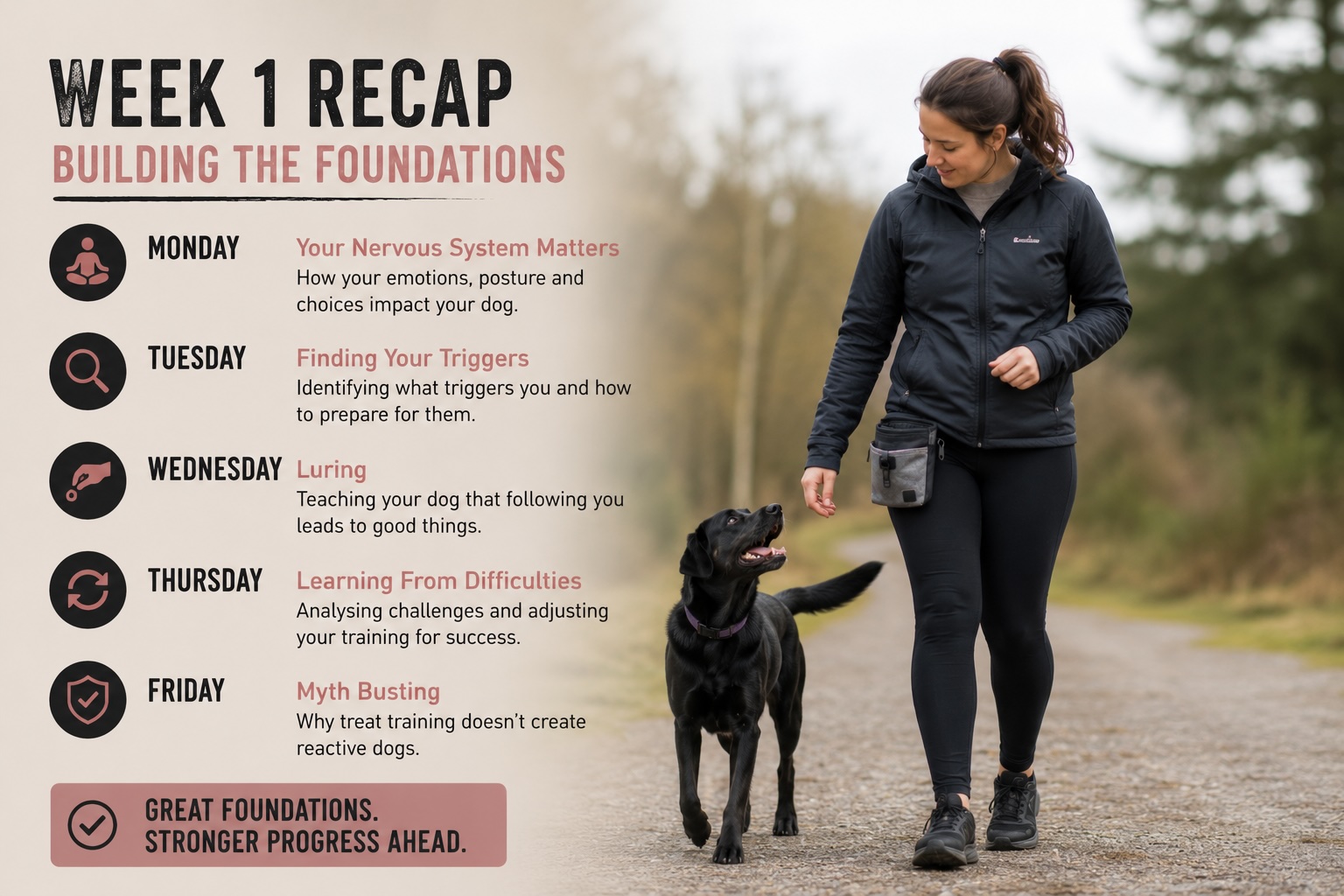
Congratulations on completing your first week of the Reactive Dog Reset Challenge.
This week wasn’t about stopping barking, fixing lunging or solving reactivity overnight.
It was about building the foundations that everything else in this challenge will rely on.
Without strong foundations, every advanced technique becomes harder.
With them, your training becomes clearer, more consistent and much more effective.
Let’s recap what you’ve learned.
Monday: Your Nervous System Matters
We started somewhere that many training plans overlook…
You
We explored how your own emotions, stress and anticipation can influence your dog’s behaviour before you’ve even said a word.
Reactive dog owners often spend walks expecting something to happen.
That leads to:
- Tightening the lead.
- Holding your breath.
- Raising your shoulders.
- Scanning constantly.
- Bracing for the worst.
None of this makes you a bad owner.
It’s a completely normal response after living with a reactive dog.
The important lesson was recognising that your nervous system is trainable too.
The more aware you become of your own emotional responses, the more control you’ll eventually have over them.
Tuesday: Finding Your Own Triggers
Once you understood that your own emotions matter, we explored what actually triggers them.
For many people, it’s not the reaction itself.
It’s seeing another dog in the distance.
Walking down a narrow path.
An off-lead dog.
Busy environments.
Certain locations.
Previous bad experiences.
By recognising your own triggers, you begin preparing for them rather than simply reacting to them.
Awareness is always the first step towards change.
Wednesday: Luring
This was your first practical skill.
Rather than expecting your dog to simply pay attention because they’re attached to a lead, we started teaching them something much more valuable…
Following you is rewarding.
You learnt:
- What a lure is.
- Why luring isn’t bribery.
- How to guide movement correctly.
- Why timing matters.
- Why we gradually fade the lure.
- How this becomes the first building block of engagement.
Most importantly…
We’re not teaching your dog to chase food.
We’re teaching your dog that staying connected with you consistently leads to good things.
Thursday: Learning From Difficulties
Every dog learns differently.
And… every handler learns differently too.
That’s why we spent Thursday reflecting on the challenges you encountered.
Rather than deciding…
“My dog can’t do this.”
We encouraged you to ask…
“What can I change to help my dog succeed?”
That shift in mindset is incredibly powerful.
Great trainers don’t blame dogs.
They adjust the environment.
They adjust the reward.
They adjust their timing.
They adjust themselves.
The dog simply gives them information.
Friday: Myth Busting
Finally, we tackled one of the biggest misconceptions in modern dog training…
That food creates reactive dogs.
Hopefully you now understand that food is simply a teaching tool.
It isn’t the training itself.
Just like a lead, a toy or a clicker, it’s only as effective as the person using it.
Poor timing, poor mechanics and poor planning can create problems with any training method.
Good mechanics create learning.
The objective isn’t to have a dog that works because food is visible.
The objective is to build such a strong history of reinforcement that your dog enjoys working with you.
What Should You Have Achieved This Week?
By the end of Week 1 you should have:
✅ A better understanding of your own emotional responses.
✅ Greater awareness of the situations that make you anxious.
✅ Begun teaching your dog that following you predicts good things.
✅ Started developing your training mechanics.
✅ Learnt to analyse training sessions instead of judging them.
These may not seem like huge achievements yet…
But, they are the foundations that everything else in this challenge will be built upon.
Before You Move Into Week 2…
Ask yourself these questions:
- Am I becoming more aware of my own body language?
- Does my dog understand the luring exercise in a quiet environment?
- Have I kept my sessions short and enjoyable?
- Have I focused on quality over quantity?
- Have I been adapting my training instead of repeating the same mistakes?
If the answer is “not yet” to any of these…
That’s absolutely okay.
Don’t rush ahead.
Re-watch this week’s lessons if you need to. You have them to recap on whenever you need to.
Repeat the practical exercises.
Training isn’t about ticking boxes.
It’s about building solid foundations.
Remember…
Reactive dog rehabilitation isn’t one breakthrough.
It’s hundreds of small wins that gradually become your new normal.
You’ve already taken the hardest step.
You’ve started.
Now let’s build on it together in Week 2.