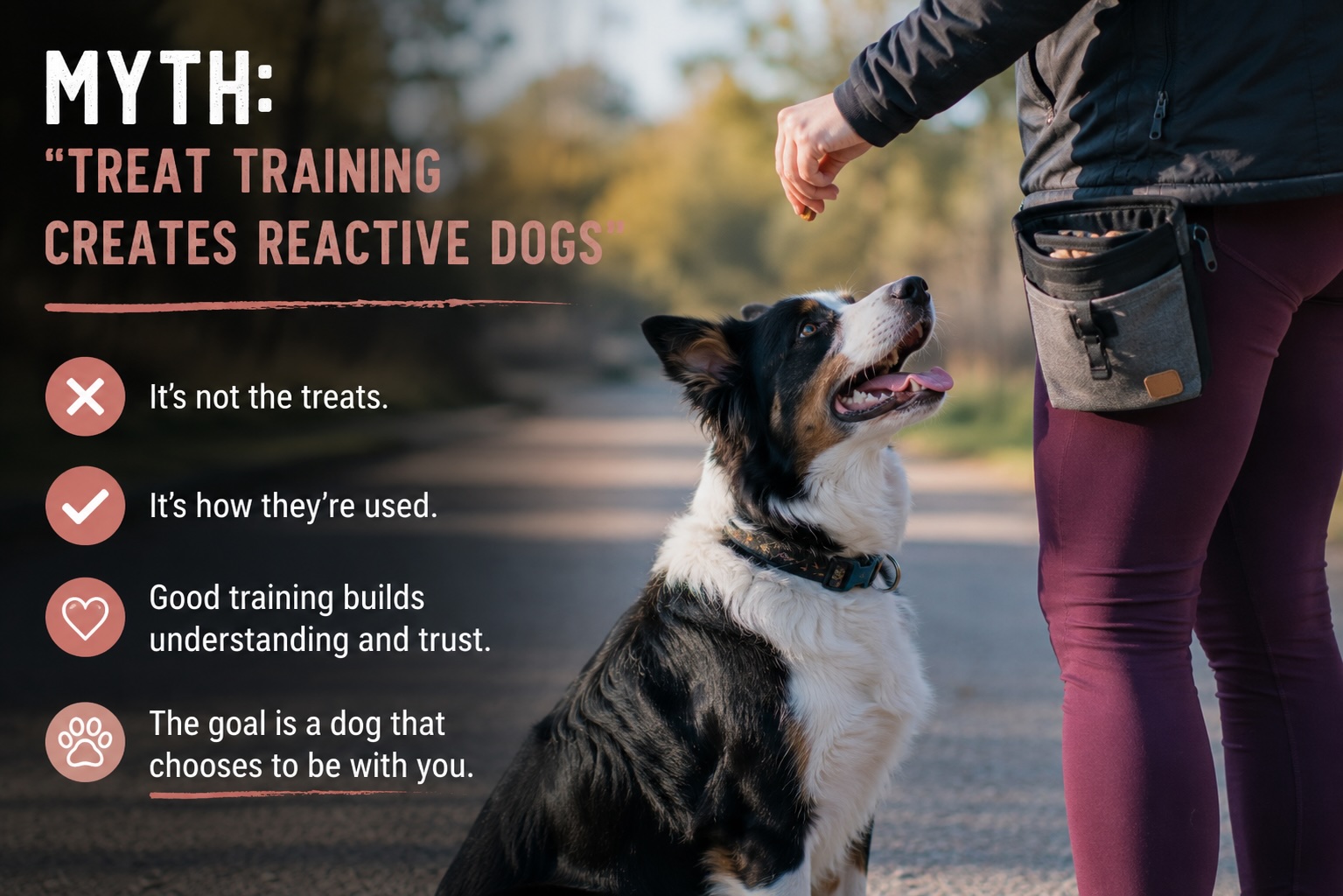
: Treat Training Creates Reactive Dogs
If you’ve spent any time on social media recently, you’ve probably heard someone claim that positive reinforcement or treat training is the reason why so many dogs are reactive.
Today’s lesson looks at where that belief comes from and why it’s based on a misunderstanding of how reinforcement actually works.
Like any training tool, food can be used well or used poorly.
If a dog is constantly distracted by treats, only responds when food is visible, or appears to ignore the handler altogether, that doesn’t automatically mean positive reinforcement has failed. More often, it means the mechanics of the training need improving.
This week you’ve already learnt that luring is just the first step. As your dog understands the behaviour, the lure is gradually faded and the rewards become part of a much bigger learning process.
The objective has never been to create a dog that only follows food.
The objective is to create a dog that enjoys following you.
Key Takeaways
- Food is a teaching tool, not the end goal.
- Luring and bribing are not the same thing.
- Good timing is more important than constantly feeding treats.
- Reinforcement builds habits when it’s applied correctly.
- The quality of the training matters far more than the type of reward being used.
As you continue through this challenge, try to judge training methods by how they’re applied, not by short clips or sweeping statements you see online.
Good training isn’t about choosing sides.
It’s about understanding how dogs learn and applying those principles in a way that helps both ends of the lead succeed.